FIN – The Game
"Find all three members of Studio Fin and collect the keys needed to escape the labyrinth while learning more about the studio!"
Role: Game Producer & Lead Developer
Development time: 5 months
Team Size: 4
Engine: Unity
Methodology: Hybrid
Programming language: C#
Project management: Trello
Tools: Git & GitHub
Genre: 2D Maze, Arcade Game
Platform: Web
Year: 2024


About FIN – The Game
FIN – The Game is a short 2D maze game I developed together with Studio Fin, an Icelandic design company. I created it in Unity with C# over approximately five months as a special project for Studio Fin’s third-anniversary event, where it was presented to the guests.
The game begins in the ruins of a post-apocalyptic world, where the player finds an old game console. When the console suddenly turns on, the player is transported into a retro labyrinth.
Inside the labyrinth, the player must find three members of Studio Fin, collect the keys needed to escape and finish the game before time runs out. Each character represents a real member of the company, allowing players to learn more about Studio Fin while playing.
The main idea was to introduce the company and its team through a video game instead of a traditional presentation.
My Role
I worked as the Game Producer and Lead Developer. Studio Fin provided the original concept, ideas, company information, one visual asset and the music selection, while I planned and developed the game, created and implemented the remaining content, managed feedback and brought the complete project together in Unity.
My responsibilities included:
-
Communicating with Studio Fin and gathering project requirements
-
Discussing ideas, feedback and possible changes with the client
-
Defining and managing the project scope
-
Planning and prioritising the development work
-
Turning client feedback into practical changes
-
Explaining technical possibilities and limitations
-
Managing the project and version control through GitHub
-
Developing the game in Unity with C#
-
Programming movement, interactions and collectible systems
-
Creating the countdown, time-reward and scoring systems
-
Building and setting up the labyrinth
-
Integrating the artwork and music provided by Studio Fin
-
Testing and fixing gameplay issues
-
Preparing and delivering the final playable version
Working in both roles gave me a better understanding of how production decisions affect development. I needed to think about what Studio Fin wanted, how long each idea would take to implement and what was realistic within the available time.
Project Goals
The main goal was to create a game that Studio Fin could present at an event. It needed to represent the company and its team while being simple enough for visitors to understand without a long explanation.
The players could have very different levels of gaming experience, so I wanted the controls and objective to be clear from the beginning. I built the game around a simple loop: explore the labyrinth, find the Studio Fin team members, collect the keys and escape before the timer runs out.
I also wanted each playthrough to be short enough for an event environment, where several people might be waiting to try the game.
Since I was programming the game myself, I needed to keep the scope realistic, prioritise the most important features and leave enough time for testing before the event.
Production Process
I worked closely with Studio Fin throughout development. They provided some of the artwork and music, as well as information about the company, its team and the original idea for the game. My responsibility was to turn those different elements into one complete and playable experience.
I used Trello to organise the development work, track feedback and separate the essential features from optional improvements. This helped me keep the scope under control and see what still needed to be completed before the final version could be delivered. I also used GitHub for version control throughout development. This helped me keep track of changes, protect working versions of the game and return to an earlier version if something went wrong while adding new features.
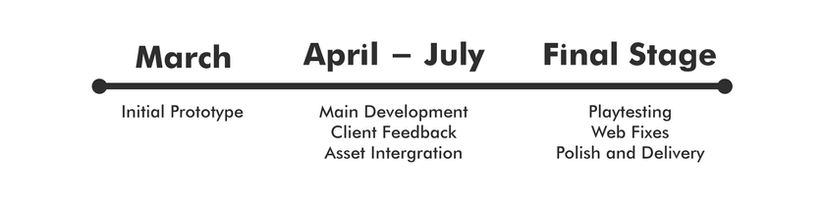
The development was divided into three main stages:
March – Initial prototype
I created the first playable prototype and focused on testing the main idea. This included the basic movement, maze structure and the core objective of finding characters and collecting the keys needed to escape.
April - July – Development and finalisation
After the initial prototype was working, I continued developing the gameplay systems, building the labyrinth, integrating Studio Fin’s artwork and music, and adding features such as the timer, coins, scoring and character interactions. I regularly showed the game to Studio Fin, gathered their feedback and adjusted the game based on our discussions.
During the later stages, I focused more on playtesting, fixing gameplay problems, improving the web version and preparing the final playable build.
When an idea would have required too much time or technical work, I explained the limitations and suggested alternatives that still supported the main concept. Because I was both producing and developing the game, I also had to make sure that new feedback would not cause the scope to grow too much.
Challenges and Solutions
One of the main challenges was making the game work well for an event audience. Some visitors played games often, while others had very little experience, so the controls and objective needed to be clear almost immediately.
I kept the controls simple and built the game around one easy-to-understand goal. The timer kept each playthrough short enough for the event, while finding characters and keys gave the player extra time and encouraged them to keep exploring.
Another problem appeared during playtesting because the game was made for the web. Browser games can behave differently from PC or mobile builds, and I discovered that clicking too quickly could sometimes push the player outside the game boundaries. I researched how input works in web games, looked into the limitations and unusual behaviour that can happen in browser builds, and adjusted the game so the player could no longer leave the playable area.
I also needed to balance Studio Fin’s ideas with what was realistic to develop. Not every idea could be added exactly as first imagined, so we discussed different options and adjusted some features while keeping the main concept and purpose of the game intact.
Gameplay
The player explores the labyrinth, finds the three Studio Fin characters and collects the keys needed to escape.
The main gameplay features include:
-
Four-directional movement
-
Maze exploration
-
Three Studio Fin characters to discover
-
Keys required to complete the game
-
Collectible coins
-
A countdown timer
-
Additional time awarded for finding characters and keys
-
Character interactions
-
A scoring system
-
Sound controls
The player begins with 40 seconds. Finding characters and collecting keys adds more time, encouraging the player to continue exploring while managing the countdown. The controls were intentionally kept simple so that event visitors could begin playing with little or no explanation.
Playtesting Feedback
Playtesting focused mainly on whether people could understand the game without a long explanation. I paid attention to how quickly players understood the controls, whether they knew what they were looking for and whether the timer made the game feel exciting without making it too difficult.
The testing helped me find the web-build problem where fast clicking could move the player out of bounds. It also gave me a chance to make sure the full gameplay loop worked properly, from finding the characters and collecting the keys to reaching the ending.
At Studio Fin’s third-anniversary event, the game was played by more than 100 people and received a very positive response. Players found it enjoyable and approachable, and the difficulty was not too high for people who did not usually play games. The game worked especially well because it introduced the audience to Studio Fin’s owners in a casual way, using small facts and details about their personalities instead of presenting the company through a traditional speech or slideshow.
Outcome
I completed and delivered a playable version of FIN – The Game within the development period. The finished game included the complete labyrinth, three Studio Fin characters, collectible keys and coins, a countdown system, scoring and a clear beginning and ending.
The game was presented at a Studio Fin event, where it was played by more than 100 people. It gave the company a more interactive and memorable way to introduce itself and its team to visitors.
For me, the project was an opportunity to work with a real client and take a game from the first idea to a finished product created for a specific event and audience.
What I Learned
This project taught me a lot about working with a client and turning their ideas into a finished game. I learned how important it is to understand what the client actually needs, communicate clearly and be honest about what is possible within the available time.
I also learned that games made for events need to be easy to understand almost immediately. Some people may only play for a few minutes, and they may not normally play games at all. Because of this, the controls, goals and feedback needed to be clear from the beginning.
Most importantly, the project gave me experience working as both the Game Producer and Lead Developer. I had to plan the project, manage its scope, communicate with the client and respond to feedback while also developing the game myself. This helped me better understand the connection between production planning and the actual work required to deliver a finished game.